
Every electrosurgical unit offers one or both of these two modes, and the choice shapes what a machine can do in theatre. This guide explains how monopolar and bipolar cautery each work, where each is used, the honest disadvantages of both, and how to choose — including why most operation theatres in Pakistan end up with a combined unit.
How each mode works
Monopolar cautery. Current flows from the handpiece electrode, through the patient's body, and out through a large return plate (patient plate) placed on the skin. Because the current concentrates at the small handpiece tip, that is where the cutting and coagulation happen. Monopolar is the general-purpose mode: it cuts as well as coagulates, works across large areas, and handles the bulk of general surgery.
Bipolar cautery. Current flows only between the two tips of a forceps — in one tip, through the tissue held between them, and back out the other tip. Nothing passes through the rest of the body and no return plate is needed. The effect is small, precise and localised: ideal for sealing a specific vessel or working on delicate tissue.
Side by side
| Monopolar | Bipolar | |
|---|---|---|
| Current path | Handpiece → body → return plate | Between forceps tips only |
| Return plate needed | Yes | No |
| Can cut tissue | Yes | No (coagulation only, in standard use) |
| Working area | Large, general | Small, precise |
| Typical work | General surgery, incisions, broad coagulation | Delicate coagulation, ENT, gynae, small vessels |
| Main risk to manage | Plate contact — a poorly placed plate can cause a burn at the contact site | Limited power and reach — not suited to large-area work |
The disadvantages of monopolar cautery — stated plainly
Monopolar's weakness is the flip side of its design: the current crosses the body, so the return path must be managed properly.
- Return-plate burns are the classic risk. If the patient plate loses full contact, the current concentrates at the remaining contact point. Modern units answer this with patient-plate contact monitoring, which alarms or stops output when contact is poor — treat that feature as non-negotiable when buying.
- Interference and stray current require sensible setup: correct plate placement and cable discipline are part of safe monopolar work.
- Less precision at delicate sites. Where a vessel sits among structures you must not touch, monopolar's broader effect is the wrong tool — that is bipolar's home ground.
None of this makes monopolar unsafe; it makes setup and safety systems matter. It remains the mode theatres use most, every day.
The limits of bipolar cautery
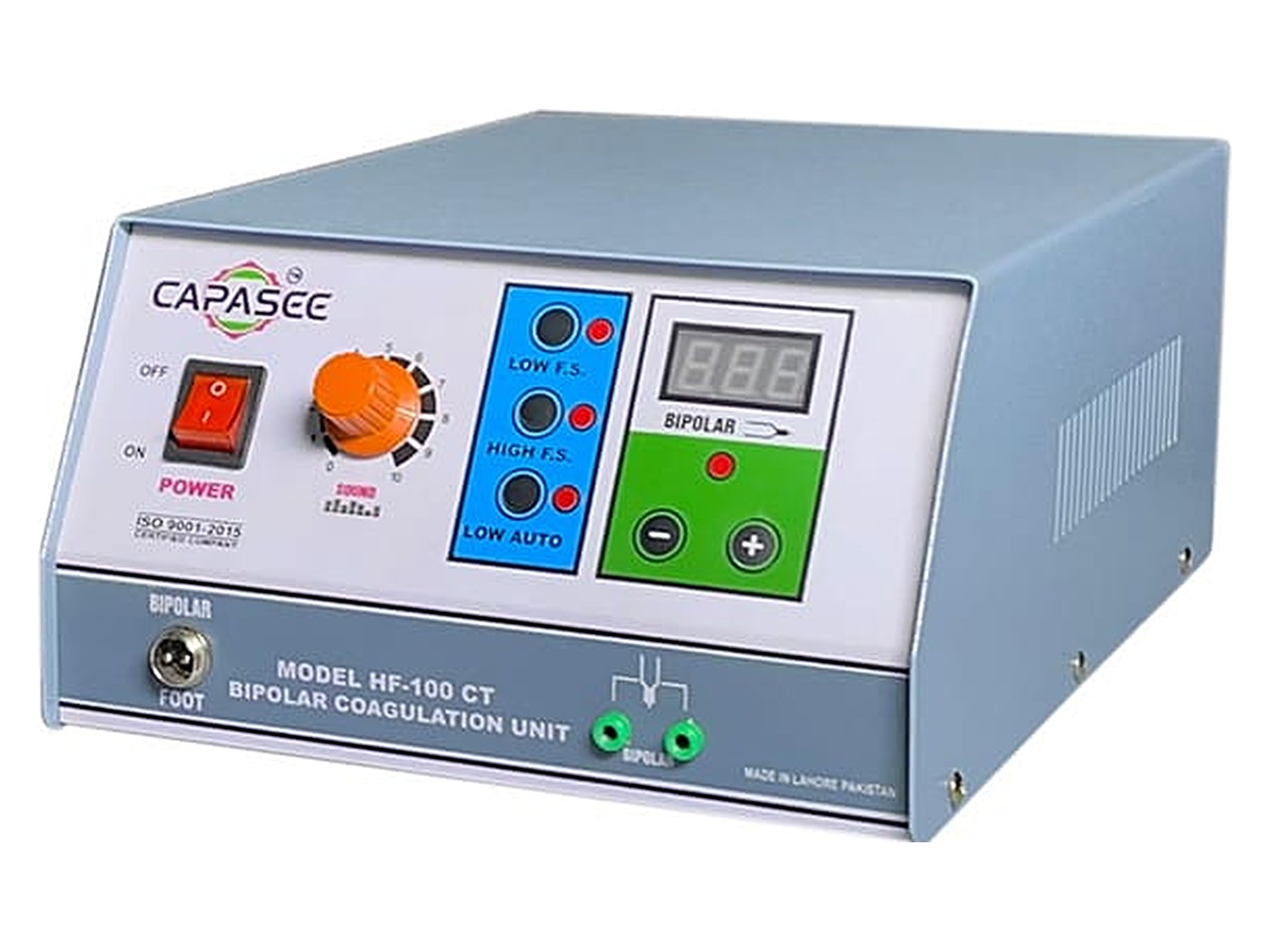
Bipolar's limits are equally plain: it does not cut, its effect is confined to what the forceps can hold, and it is slower across large areas. A bipolar-only unit is a specialist instrument, not a theatre's main machine — which is why dedicated bipolar units are bought for precision lists (Capasee's HF-100 CT Bipolar, PKR 125,000) while general theatres buy combined machines.
So which should you buy?
- General OT / mixed lists: a combined unit — monopolar for cutting and general work, bipolar available the moment delicate work appears. Capasee's range runs from the HF-300 CT (PKR 85,000) and HF-400 CT (PKR 105,000) to the flagship HF-450 (PKR 195,000).
- Clinics doing minor procedures: a monopolar-led unit such as the HF-250 CT (PKR 76,000) covers clinic lists comfortably.
- Precision speciality benches (derm/ENT/delicate gynae): add the dedicated bipolar or RF unit for that bench.
Background reading: the electro surgical unit price guide, the surgical diathermy price guide, and our speciality-by-speciality diathermy uses guide. For advice against your own procedure list, WhatsApp Capasee: 0321-4444595.
Frequently Asked Questions
What is the main difference between monopolar and bipolar cautery?
In monopolar mode, current passes through the patient's body to a return plate and can both cut and coagulate. In bipolar mode, current passes only between forceps tips — no plate, no body path — and it coagulates precisely in a small area but does not cut.
What are the disadvantages of monopolar cautery?
Its current crosses the body, so it depends on correct return-plate contact; poor contact can cause a burn at the plate site. Modern units with patient-plate contact monitoring manage this risk. It is also less precise than bipolar for delicate tissue.
Is bipolar cautery safer than monopolar?
For delicate, localised work, bipolar's confined current path is an advantage. For general surgery, monopolar with correct setup and plate monitoring is the standard, safe workhorse. They are tools for different jobs rather than a safe/unsafe pair.
Can one machine do both monopolar and bipolar?
Yes — combined electrosurgical units offer both modes in one body, and they are the normal choice for operation theatres. Capasee's HF-300 CT, HF-400 CT and HF-450 are combined units.
Do bipolar forceps work with any electrosurgical unit?
The unit needs a bipolar output and the matching bipolar cable and forceps. Capasee supplies the forceps, cables and accessories for its units within Pakistan.