
One bad cautery can make any minor procedure a time consuming, bleeding nightmare. There are plenty of clinics and hospitals in Pakistan that are purchasing electrosurgical equipment without any idea about the power output, safe grounding, and proper after sales service. This leads to overpriced units, lack of tissue control, and delays in repair that were not anticipated. In general surgery, gynecology, ENT, and dermatology, monopolar cautery is one of the most popular cutting and coagulating methods available; it is important, therefore, that the correct one be selected for patient safety and cost.
This guide outlines the working of a monopolar cautery machine, some features to look for before buying, the expected price range in the local market, and some common pitfalls in buying such a machine. It was written by the Capasee Electro Medical Engineering team and provides you with much needed clarity before placing an order.
What Is a Monopolar Cautery Machine and How Does It Work?

A monopolar cautery machine is an electrosurgical unit that delivers high frequency current to the body via a hand held pencil and returns the current to the machine via a return pad. Controlled heat is generated by the current, which cuts tissue or seals small blood vessels. The surgeon selects the effect and the power setting.
Imagine a dermatologist excising a skin tag. In coagulation mode, once the pencil comes in contact with the base, there is very little bleeding, as the base is sealed in one go. The same principle applies to deeper incisions by a general surgeon in a day care OT at higher power.
Monopolar Cautery vs Bipolar Cautery: Which One Does Your Clinic Need?
Use monopolar for general cutting and coagulation in larger areas of tissue, and bipolar for fine cutting close to nerves and small structures. In monopolar cautery, current flows from the patient to a return pad. With bipolar, current flows only between the two tips of the forceps.
A monopolar unit is sufficient for most daily use for a small clinic that performs minor surgery. Bigger surgical centres may retain both and be able to select which one to use depending on the surgery.
Main Components of a Monopolar Electrosurgical Unit
Each monopolar electrosurgical unit contains the same basic components, each of which has an impact on safety and performance:
- Active pencil or handpiece: The surgeon uses this to apply current to tissue. Look for a comfortable grip, finger switch buttons, and a safe cable.
- Patient return electrode or grounding pad: This pad safely accepts the current from the body. Burns can occur if contact is not good, so the area of contact is important, such as placing it on a clean, dry, muscular area.
- Footswitch: It is used to activate cutting or coagulation hands free when it is necessary.
- Cutting and coagulation modes: Cutting provides a clean cut. Coagulation seals bleeders. There are many units that offer a mode of blending for both.
- Power control settings: Dials or digital controls control output in watts to match the setting for the tissue.
Read this blog too: Dental Surgical Instruments
Monopolar Cautery Machine Price in Pakistan

The monopolar cautery machine price in Pakistan varies from 60,000 to 300,000 or even higher, depending on the power output, type of control, and accessories of the machine. Budget can vary significantly, depending on the type of unit a small clinic requires, as compared to a surgical hospital.
Imagine a rural clinic and a surgical centre in the city. The clinic might require only a basic unit for minor procedures, whereas a centre might require digital control and a greater output to handle daily cases. The above prices are indications and are subject to changes in exchange rates and stock; please check for a current price before ordering.
How Much Does a Monopolar Cautery Machine Cost in Pakistan?
The table below lists the general range of prices for each machine type and buyer.
| Machine Type | Typical Use in Pakistan | Estimated Price Range (PKR) | Suitable Buyer |
| Basic Monopolar Cautery | Minor surgery, skin procedures, small clinics | 60,000 to 90,000 | Clinics and minor OTs |
| Standard Monopolar ESU | General surgery, routine cutting and coagulation | 90,000 to 150,000 | Surgeons and day care OTs |
| Advanced Monopolar Cautery Machine | Higher power output, digital controls, multi mode use | 150,000 to 300,000+ | Hospitals and surgical centres |
Purchase equipment that will be used. Purchase equipment to be used. A simple unit will suffice for those minor tasks, but a more sophisticated one that you don’t use at all is an unnecessary expense.
Factors That Affect the Price of Monopolar Cautery Machines in Pakistan
Five factors drive prices up or down:
- Power output: If you’re looking for a unit with 400 watts, it will be more expensive than a 250 watt unit, as it will take on heavier surgical tasks.
- Analog versus digital control panel: Digital panels offer accurate settings and more effective feedback, making them a higher price point.
- Included accessories and electrodes: Pencils, return pads, footswitches, and spare electrodes are added value, so look out for them in the quote.
- Warranty, installation, and after sales service: A longer duration warranty and trained installation support will cost more at the outset but will save on repair costs.
- Local manufacturing versus imported equipment: Local manufacturing might be cheaper and quicker to ship than imported equipment, but with imported equipment, there may be higher import duties and longer lead times.
A lower priced quote that comes with no warranty or service may cost more than the unit you pay a bit more for, but it has the proper service. Inquire from each supplier what they do if a part fails and how quickly they respond. That price is not the only thing this answer tells you.
Best Uses of Monopolar Cautery in Pakistani Hospitals and Clinics
Best for cutting tissue and sealing bleeders in general surgery, dermatology, ENT, gynecology, dental procedures, and minor OT procedures, monopolar cautery is used. This is because it is very versatile and is found in nearly every operating room, from private clinics to a large teaching hospital.
Visit a day care surgical center for hernia, lipoma removal, and debridement surgery in one morning. All three can be operated by a single monopolar unit with adjustable power, which helps to contain the cost of equipment and reduces OT turnover time.
Surgical Procedures Where Monopolar Cautery Is Commonly Used
It is used most by Pakistani surgeons and clinicians:
- General surgery: Incision, dissection, and coagulation in hernia repair, appendectomy, and abdominal surgery.
- Dermatology and minor skin procedures: Removal of skin tags, warts, moles, and small cysts with little bleeding.
- ENT procedures: Bleeding control during tonsillectomy, nasal work, and turbinate reduction.
- Gynecology: Bleeding management during gynecological surgery, minor excisions, and cervical procedures.
- Dental and oral surgery: Soft tissue removal, oral contouring, and hemostasis in dental surgery.
- Veterinary and minor OT applications: Small animal surgical procedures and simple procedures in the minor operating theatres where a smaller unit is sufficient.
Not all fields will require the same power setting, so a machine with a good range of power may be used for multiple departments.
How to Choose the Right Monopolar Cautery Machine for Your OT
Begin with your usual cases and then match up the machine with them. A unit that you have that will match your procedures, budget, and service support will outperform a more expensive unit that is half used.
Clinics with a low volume of skin and minor procedures perform best on a simpler unit, while a surgical center performing general surgery would require more modes and power. List your top 5 procedures first when comparing quotes.
Key Specifications to Check Before Buying
Before you commit, review these five things:
| Specification | What to Look For | Why It Matters |
| Required wattage | 100W to 150W for minor work, 250W to 400W for general surgery | Too little power slows cutting, too much risks tissue damage |
| Cutting and coagulation modes | Pure cut, blend, and coagulation | Lets you adapt to different tissue types |
| Patient safety features | Return pad contact monitoring, alarms, overload protection | Reduces burn risk at the grounding site |
| Compatibility with electrodes and accessories | Standard pencils, pads, and footswitches | Keeps replacement costs low and supply easy |
| Availability of local technical support | Service team in Pakistan, spare parts in stock | Prevents long OT downtime after a fault |
Extra Weight to Local Technical Support. An unattended strong machine can make your OT sit idle for weeks.
View Product: Our Products
Buy Monopolar Cautery Machines from Capasee Electro Medical Engineering?
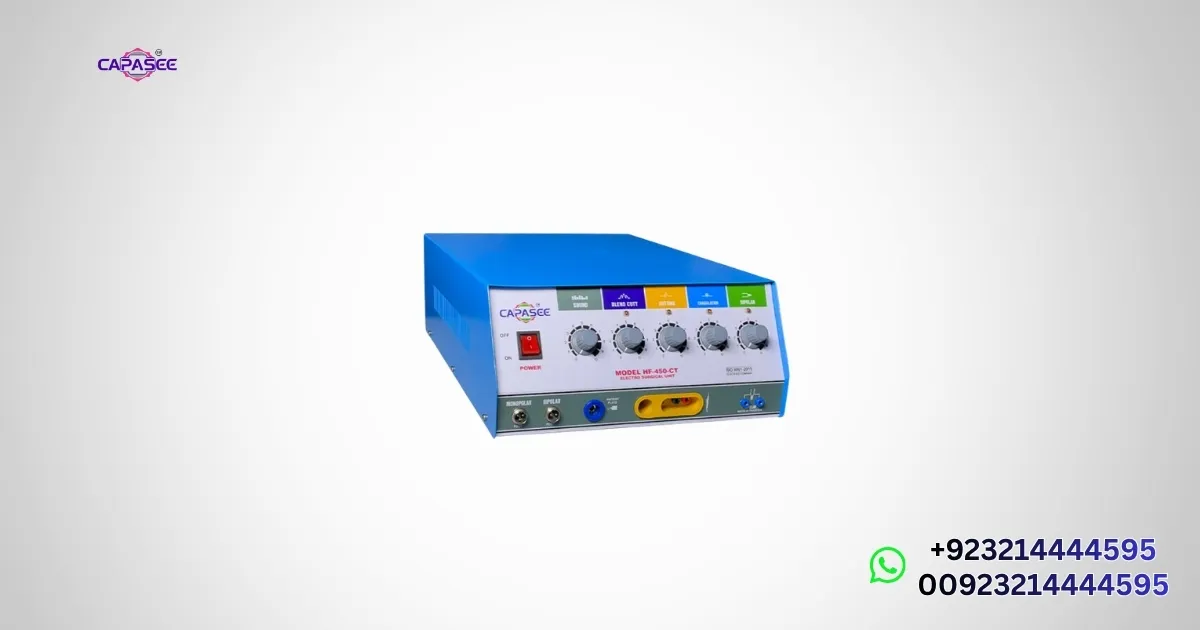
A monopolar cautery machine can be purchased by simply requesting a quote; it is delivered, installed, and taught to the operator by Capasee Electro Medical Engineering. This process is designed to be utilized by clinics and hospitals seeking transparency in pricing and reliable support.
When ordering from the supplier who provides the service, it’s one stop shopping; one person to contact for questions, parts, and repairs. This is a time saving alternative to hunting down individual dealers afterwards for purchasing.
Why Pakistani Clinics Trust Capasee for Monopolar Cautery Equipment
Clinics select their supplier for reliability, honesty in pricing, and post sale support. Capasee Electro Medical Engineering specializes in electro medical devices for medical facilities in Pakistan, considering the needs in the real world of the OTs and clinics.
Buyers also appreciate being given clear information on which model would best meet their procedures, rather than being sold the most expensive model. Include personal proof points such as years in business, number of installations, or warranty, as it adds to readers’ trust.
How to Order a Monopolar Cautery Machine in Pakistan
To order, follow these four steps:
- Request a price quote: When you call Capasee, let them know what type of clinic you are and what type of procedures you are trying to quote them.
- Confirm required power output and accessories: Ensure that the wattage, modes, pencils, return pads, and footswitch are all accounted for.
- Arrange delivery and installation: Have the delivery and installation date agreed, and the unit is installed and tested in OT.
- Receive operator guidance and after sales support: Your employees are trained hands on, and you have access to operator service in case of a fault.
Don’t separate the quotation, warranty card, and service contact. It speeds up any support request you may need to make in the future.
FAQs
What is a monopolar cautery?
Monopolar cautery is a type of electrosurgical technique in which high frequency electricity from a pencil electrode is passed through the patient into a return pad. This is used to heat the tissue to cut it or close the bleeding vessels. It is used by surgeons in general surgery, ENT, gynecology, and dermatology.
What is the difference between monopolar and bipolar cautery?
Monopolar cautery is used by passing current through the patient to a return pad; bipolar passes current between two tips of the forceps. Narrowing and widening of the coagulation. Bipolar provides closer control and is the preferred choice of the surgeon when working with delicate tissue and small structures.
What’s the difference between bipolar and monopolar?
The main difference is that the current path is different. Unlike other parts of the omnibracelet, bipolar is always connected between its two tips; hence, it does not require a return pad and dissipates less energy in the body. Monopolar requires a pad, but it provides greater power, faster cutting, and wider coagulation.
Is monopolar cautery the same as electrocautery?
No, it’s not the same. Electrocautery uses a heated metal tip and burns tissue, but no current goes into the patient. Monopolar cautery is electrosurgery, a surgical technique using an electric current that is passed through the body, causing the tissue to heat up. Many people refer to it interchangeably, but the technique is different.
Why does monopolar cautery need a return pad?
The return pad is used to safely return current out of the body, completing the circuit. It has a large surface, which is responsible for diffusing the current so that it does not raise the skin’s temperature. Burns can occur because of poor contact when it is placed on clean, dry, muscular skin.
What are the main modes of operation?
The principal modes are cut, coagulation, and blend. When cutting, you’ll get a clean cut with minimal heat distribution from the cut. Small bleeders that do not cut deeply will coagulate. Blend is a mix of both; you can both cut and control bleeding. Adjust the power (in watts) to match the tissue.
How does it differ from bipolar cautery?
When using monopolar cautery, it is important to make sure that there are no stray current burns, and the return pad placement must be checked. Be safe around nerves, small digits, and patients with implanted devices; bipolar confines current to forceps tips. While bipolar is still the superior option for larger, faster cuttings, monopolar is the better option for cutting faster.
Can monopolar cautery interfere with pacemakers or ICDs?
Yes, it can. Surgery could interfere with the electrical current, so those with pacemakers or ICDs should have a plan in place. Bipolar tools and short bursts, careful pad placement, and cardiology advice are common tools used by teams. Always seek the patient’s cardiologist’s advice.
Conclusion
Selecting the right monopolar cautery machine boils down to three points; sizing, matching wattage and procedures, and safety features, such as return pad monitoring, and a local service provider that backs the product with service. Do those right, and you’re saving your patients, your budget, and your OT schedule.
There is a lot of variation in prices in Pakistan, so a clear price and a clear warranty are as important as the machine itself. Decided to go ahead? Give Capasee Electro Medical Engineering the type of clinic you are and the procedures you anticipate, and ask them to give you a quote that is tailored to your specific needs. Good surgical equipment cuts tissue but isn’t just that. It cultivates the trust that will attract patients to your clinic again and again.