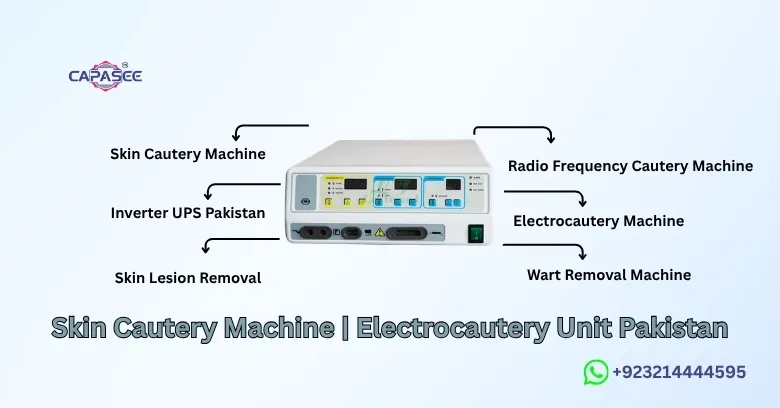
Skin tags, warts, moles, small lesions, freckle work — a large share of daily dermatology and aesthetic practice in Pakistan runs on one machine: the cautery unit. Chosen well, it is also one of the fastest-paying machines a clinic buys, because the procedures are short, frequent and charged per session. This guide explains what dermatologists actually need from a cautery machine, the difference between radiofrequency (RF) and standard electrocautery, and what the right machines cost in Pakistan.
What a dermatology cautery machine must do well
Dermatology work is precision work at low power. The machine is treating skin that the patient will look at every day, so three things matter more than raw wattage:
- Fine, stable low-power control. The useful range for skin work sits at the bottom of the dial. A unit that jumps in coarse steps will frustrate delicate work; smooth adjustment matters.
- The right electrodes and handpiece. Ball, needle and loop tips each have their procedure. Check that the machine's kit covers the tips your practice actually uses — and that replacements are available in Pakistan.
- A bipolar option for delicate areas. For work where current must stay exactly between the forceps tips, a bipolar mode gives the control monopolar cannot. Clinics doing mixed minor surgery often end up wanting both.
RF cautery vs standard electrocautery — what is the difference?
Both use high-frequency current, but radiofrequency (RF) skin cautery works at a higher frequency with a finer effect on tissue. In practice, dermatologists prefer RF units for cosmetic skin work — tags, moles and surface lesions — because the energy is concentrated at the very tip, which suits precise, superficial procedures. Standard electrosurgical units cover a wider range: the same machine that does clinic skin work can also handle general minor surgery, which is why mixed practices often choose a mid-range ESU instead of a dedicated RF unit.
Capasee machines for dermatology — prices
| Model | Price (PKR) | Best for |
|---|---|---|
| HF-100 CT RF Skin Cautery Machine | 95,000 | Dedicated dermatology and aesthetic practice — skin tags, warts, moles, lesion work |
| HF-100 CT Bipolar Coagulation Unit | 125,000 | Precision bipolar work on delicate tissue |
| HF-250 CT | 76,000 | Mixed practice — dermatology plus general minor procedures |
| HF-50 CT (analog) | 65,000 | Budget entry for basic skin cautery work |
The full electrosurgical range is on the electro surgical units page, and our general guides cover cautery machine prices and surgical diathermy prices across all specialities.
The economics: why clinics recover the cost quickly
Dermatology cautery procedures in Pakistan are commonly charged between PKR 2,000 and PKR 10,000 per session, depending on the procedure and the clinic. At those rates, a dedicated RF skin unit at PKR 95,000 is covered by a modest number of sessions — after which the machine is pure capacity: short procedures, high patient turnover, no consumable cost beyond electrodes. This is why skin cautery is usually the first electrosurgical purchase a new aesthetic or dermatology practice makes, ahead of larger theatre equipment.
Before you buy — dermatology checklist
- Confirm the electrode/tip set in the box matches your procedure list.
- Check low-end power control on a demo if possible — that is where you will live.
- Ask about electrode availability and price for replacements; tips are the only recurring cost.
- Confirm warranty and local service — a machine earning daily should not wait weeks for a repair.
- If you also do minor surgical work, price a mid-range ESU (like the HF-250 CT) against a dedicated RF unit before deciding.
For today's confirmed price, stock and delivery time, WhatsApp Capasee on 0321-4444595. Capasee has supplied dermatology and aesthetic clinics across Pakistan since 1986, and the team can match the model to your procedure list before you spend.
Frequently Asked Questions
What is the price of a skin cautery machine in Pakistan?
Capasee's dedicated RF skin cautery machine, the HF-100 CT, is PKR 95,000. Basic cautery units suitable for simple skin work start from PKR 65,000 (HF-50 CT).
Which cautery machine is best for a dermatology clinic?
For a dedicated dermatology or aesthetic practice, an RF skin cautery unit such as the HF-100 CT is the usual choice. Clinics that also perform general minor surgery often prefer a mid-range electrosurgical unit (HF-250 CT) for its wider range.
What is the difference between RF cautery and electrocautery?
RF cautery uses a higher-frequency current concentrated at a fine tip, suited to precise, superficial skin procedures. Standard electrocautery covers a broader range of cutting and coagulation work. Many practices use RF for cosmetic skin work and a general ESU for everything else.
How much do clinics charge for cautery procedures in Pakistan?
Commonly between PKR 2,000 and PKR 10,000 per session, depending on the procedure, the number of lesions and the clinic.
Are electrodes and tips available locally?
Yes — Capasee supplies the electrodes, handpieces and accessories for its units within Pakistan, along with warranty and after-sales service.